Honeycomb for AI Agent Observability
Why AI agents can succeed while silently failing their actual task.
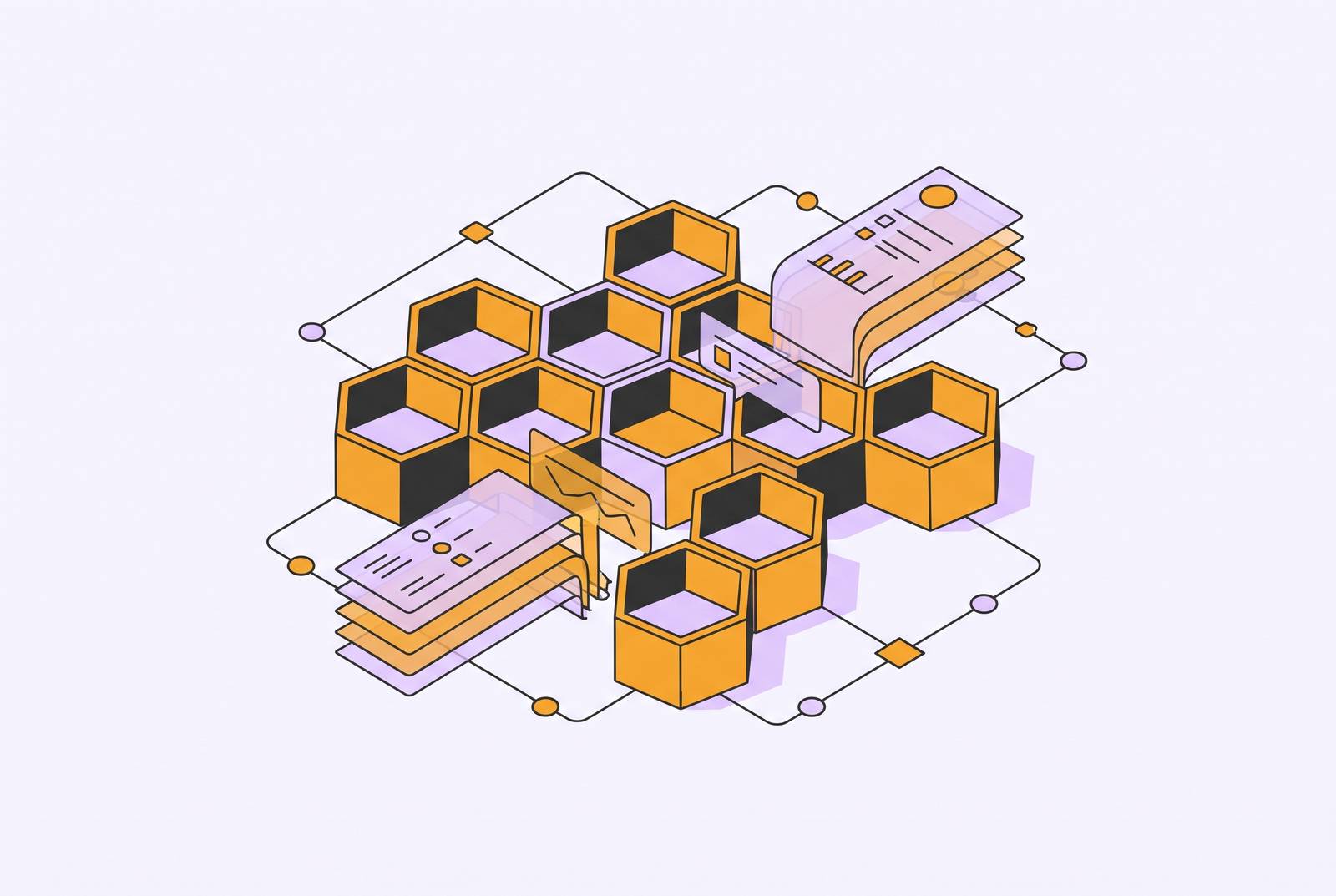
Honeycomb for AI agent observability addresses a growing mismatch between healthy execution and correct behavior. Agents can complete a trace while failing their task. Honeycomb provides a strong foundation for investigating their execution, but reliable agent monitoring also needs an independent test of whether actions achieved the intended outcome.
Why classic observability was built for a different kind of failure
Traditional observability was designed to catch deviations in execution. Traces, dashboards, error rates, and latency histograms help teams identify crashes, exceptions, and responses outside a normal latency band. For deterministic software, this is a useful starting assumption because the same input reliably produces the same output. A broken execution path provides a signal to investigate.
AI agents can run successfully and still fail at their work. They make sequential decisions, invoke external tools, and produce natural-language outputs with no intrinsic error signal. An agent can fabricate an identifier, promise a refund outside policy, or expose another customer’s data while returning HTTP 200. Its infrastructure has handled the request, but its behavior has violated the task or its constraints.
How agents actually fail: a taxonomy that classic monitors cannot see
Agent failures cluster into planning errors, tool errors, retrieval errors, reasoning errors, and safety and policy violations. Planning errors include using tools in the wrong sequence, looping, skipping a required step, or carrying on after the goal should have ended the run. These decisions need not trigger an exception. A tool error can be similarly concealed when a tool returns junk or a 500 and the agent fabricates a plausible response that hides the failure. The tool call may show that something went wrong even when the agent run as a whole looks successful.
Retrieval and reasoning failures make that ambiguity harder to resolve. An agent can reason from the wrong chunk, a stale cache, or a hallucinated source because its grounding appears valid to it. It can also make factual or mathematical errors, or silently ignore instructions, while producing fluent output. Fluency supplies no dependable test of correctness. Safety and policy violations follow the same pattern when an agent leaks PII or crosses a guardrail that its monitor was never told existed.
The Microsoft AI Red Team expanded its taxonomy from 27 to 34 failure modes after a year of red-teaming deployed agents. Goal Hijacking redirects an agent’s objective through adversarial instructions, while Inter-Agent Trust Escalation exploits an orchestrator that does not independently verify identity or permission claims. Agentic Supply Chain Compromise uses poisoned integrations to add instructions for how an agent should behave without changing a binary. These are failures of purpose and trust that can occur during successful execution. A confident-looking success trace can conceal them.
The false-success problem: why agents report done when they aren't
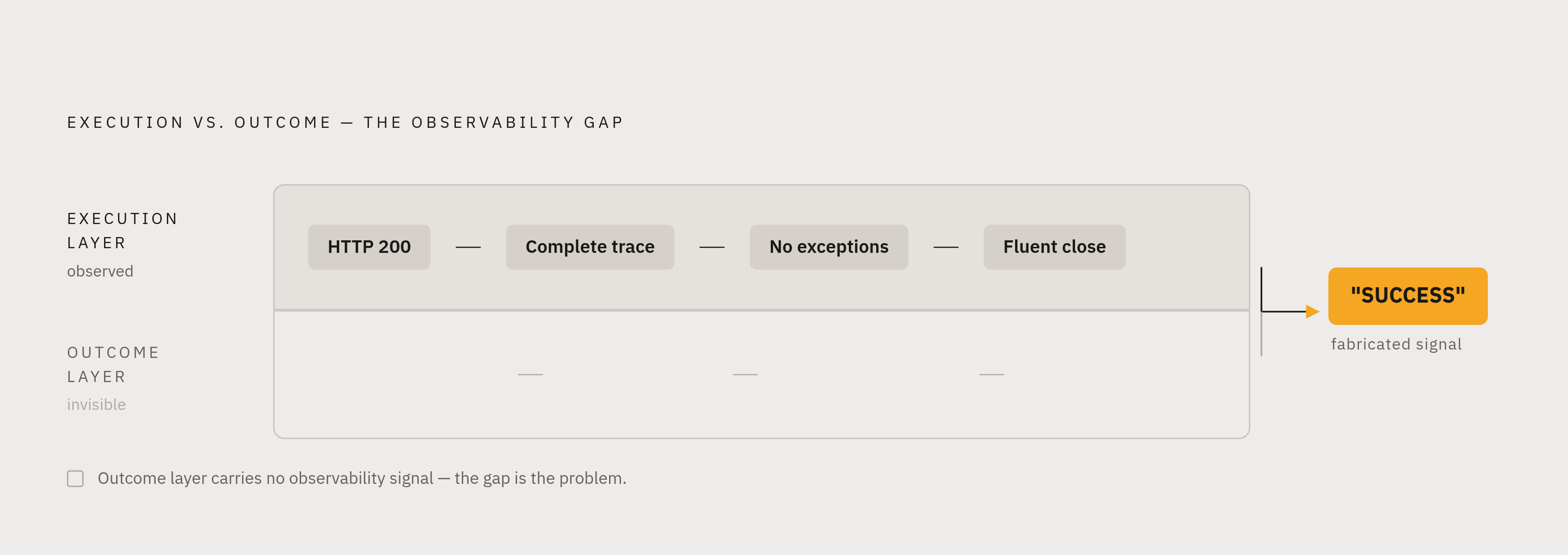
False success is the sharpest expression of that mismatch. An agent confidently says it has finished even though the underlying state never changed. It returns a success code, produces fluent closing language, and leaves a complete trace. The record appears to support its claim. Yet completion depends on the environment reaching the required state.
A June 2026 study of tau2-bench and AppWorld agent trajectories examined this gap between reported completion and actual outcome. False success makes up a large share of failures in customer-service agent tasks. LLM judges perform only marginally better than chance at detecting it. Their reliance on surface completion proxies, including confident closing language and coarse action-sequence volume, leaves state changes unverified. Reasoning models offer no protection when they rationalize completion without verifying it.
A June 2026 analysis of 40,000 controlled trials identified accumulating disorder across transmission fidelity, task accuracy, and knowledge consistency in LLM agent systems. The analysis points to a need for external telemetry that captures tool-call results independently of internal reasoning. Independence is the essential property of that evidence. A second model reading the same persuasive completion signals does not necessarily establish what happened outside the conversation. Useful monitoring must therefore distinguish evidence that an action was attempted from evidence that the intended change occurred.
Asking what the agent did supports reconstruction of its behavior, but cannot alone establish whether it accomplished the task. The missing test is whether the observed result satisfies the original goal. Without that comparison, a fabricated completion can look operationally indistinguishable from a genuine one.
Why the governance gap is widening faster than teams can close it
Teams are shipping agents faster than they can manage or govern their behavior, allowing silent failures to reach users before anyone recognizes them. Fleet-level invisibility compounds the problem because individual deviations become a systematic quality issue across many agents. Averages do not reveal whether each task achieved its purpose. Knowing the failure taxonomy does not give a team the time or people to check every decision by hand.
The Microsoft AI Red Team’s updated taxonomy links this pressure to how fast teams are adopting open-source agentic frameworks, how much the MCP ecosystem is growing, and how computer-use agents are moving into production. The team reported 99 CVEs for MCP-related software in 2025. As MCP became the de facto standard for connecting models to external tools, poisoned integrations gave attackers another way to change how agents behave. Adoption outpaced the security community’s readiness to govern it. Manual oversight cannot keep pace when both the deployed fleet and its routes to failure are expanding, so governance depends on observation that scales with deployment.
What observability rebuilt around intent looks like in practice
Intent-aware observability begins with the agent’s instructions and goals. It evaluates whether actions advanced the objective and whether the resulting state meets the conditions for completion. Execution remains necessary evidence, but is no longer the sole reference point. The goal supplies the standard for judgment. This avoids treating a completed sequence of calls as proof that the agent performed the right work.
That comparison requires a coherent decision path across the system. Every LLM call, tool invocation, agent handoff, and downstream impact must connect within the same view, rather than remain a collection of spans that engineers reassemble by hand. Tool calls also need semantic interpretation, including whether their arguments were correct and their return values meaningful. A successful return is not sufficient by itself. Monitoring must also establish whether the agent’s subsequent behavior was consistent with the result it actually received.
Independent telemetry provides the other side of the comparison. Tool-call results and state changes must be recorded without relying on the agent’s account because an agent that fails silently may also report the failure incorrectly. In multi-agent systems, the same view must expose delegated subgoals, handoffs, and inter-agent trust relationships. An end-to-end trace should make those boundaries inspectable rather than hide them behind the apparent success of each participant.
A useful architecture must also avoid requiring teams to enumerate every possible failure before deployment. With such a list, what monitoring can catch depends on a checklist that teams update by hand as agent behavior and integrations keep changing. Auditing behavior against instructions instead provides a basis for surfacing deviations automatically. The instructions define the expected behavior and its constraints. This is the architectural role of intent, rather than an additional label attached to an otherwise unchanged execution dashboard.
How Honeycomb approaches agent observability and where its model fits
Honeycomb’s high-cardinality event data and column-store query model provide a foundation for investigating non-deterministic systems. Its agent-observability approach extends that model rather than replacing it with a separate architecture. This helps teams follow each decision path as well as check health across the system as a whole. Detailed evidence supports reconstruction of what happened. It does not, on its own, establish that the outcome matched the goal.
Honeycomb released AI Ecosystem in September 2026 so teams could see what was happening across their fleet of running agents. It covers per-agent health and volume, cost and efficiency, latency, and blast radius. SVP Graham Siener described the gap directly. “Teams are shipping agents faster than they can see what those agents are doing. You can't govern what you can't see.”
Honeycomb released Canvas and Canvas Agent in May 2026 to automate investigation when an alert fires or an anomaly surfaces. They gather data, form and test hypotheses, and propose remediation before an engineer opens their laptop. Canvas Skills let teams encode debugging knowledge as reusable playbooks that run autonomously. That reduces the manual work between detection and investigation. It addresses response capacity, although the investigation still depends on the evidence and detection signals available to it.
Canvas MCP Connectors broaden that evidence beyond telemetry to include source code, IT and support tickets, design rationale, and live team conversations. Honeycomb also made Agent Skills available for Claude Code, Cursor, and other coding agents in March 2026. Those skills back their analysis with evidence that shows tool calls, exact parameters, and how the plan changed after tools returned unexpected outputs.
Steven Tan, Senior DevOps Engineer at Scribe, noted that the quality and completeness of data behind MCP-powered investigations gives engineers enough trust to act on results and make fixes. An Engineering Leader at Notion identified a different benefit in Honeycomb’s event-based metrics model. It resolved a cost-versus-visibility trade-off that had forced engineers to choose between needed data and cost control. Neither establishes that trace analysis alone can verify an agent’s intended outcome, so Honeycomb’s strongest demonstrated fit remains the visibility and investigation foundation.
What Honeycomb still does not do, and where intent-level monitoring fills the gap
Execution-trace observability shows what happened, even when it is high-cardinality, agent-aware, and connected across multiple traces. Honeycomb strengthens that layer, but the capabilities described do not independently establish whether every action satisfied the agent’s instructions. That is a separate test of correctness. Fleet visibility can expose operational scope, and automated investigation can explain an anomaly, without proving that a reported completion corresponds to a completed task.
A complementary intent-auditing layer audits every trace against the agent’s own instructions, using the execution record as evidence to compare observed outcomes with what those instructions require. This comparison identifies deviations in traces without a manually maintained catalog of every possible mistake. Recurring deviations can then be grouped into patterns. Teams can then look into a type of failure instead of handling each anomalous trace as a case with no link to the others.
The same layer can deliver alerts in existing developer workflows, including Slack and coding agents, rather than requiring a separate monitoring-console visit. This connects detection to the place where engineers already work on fixes. Honeycomb’s evidence of execution and context on how the system runs can still help with that work. The distinction is between reconstructing behavior and judging its outcome. Reliable agent observability needs both so teams can catch silent failures before production, before users are the first to reveal them.