Benchmarking Agent Tool-Call Accuracy Across Eval Platforms
Tool-call accuracy reveals silent agent failures that traditional benchmarks miss.

Most teams shipping agents discover the same problem after their first production incident: the benchmark scores looked fine, but the tool calls were wrong. The agent returned correct-sounding answers while selecting the wrong functions, discarding results, or inventing outputs. Tool-call accuracy is a distinct measurement target from agent accuracy, and it demands its own evaluation framework.
Why tool-call accuracy is a different problem from agent accuracy
You can pick the wrong tool, pass malformed arguments, or make calls you did not need, and still get a correct final answer. The model must select the right function from a schema, fill parameters with valid types, and do so in the right sequence. That is a distinct skill, one that chat benchmarks like MMLU or MT-Bench do not exercise at all.
Four tool-failure modes exist whether or not the final answer is right. Tool-skip occurs when the agent answers from memory instead of calling. Result-ignore happens when the agent calls the tool but discards the output. Output-fabrication is when the agent invents a result that the tool never returned. Unnecessary-tool-use covers calls made when no call was needed. None of these failure modes produce an error code, and none of them show up in a task-completion score.
The four failure modes outlined here are precisely the behaviors that traditional error monitoring misses, because they don't crash the agent or produce error codes. Production monitoring platforms designed for agents detect these deviations by auditing every trace against the agent's own instructions. Lemma, for instance, surfaces the silent misbehaviors that outcome-only metrics cannot see by grouping recurring deviations into issues automatically.
The four dimensions of tool-call accuracy that evaluations must cover
Measuring tool-call accuracy requires four separate dimensions, and a platform that scores only one or two of them gives a systematically incomplete picture. The first dimension is tool selection. Did the agent call the right tool, or pick a superficially similar one with a different scope? The second dimension is argument correctness. Did the agent fill every required parameter with a valid value of the right type? A correctly selected tool called with a wrong argument type or a missing required field fails at the API boundary. This is a mechanical failure with a mechanical fix, but it still has to be caught.
The third dimension is sequencing. Did tool calls happen in the right order? Losing that context after three turns produces a wrong state even if each individual call looked valid. When a tool call fails or returns unexpected output, does the agent retry intelligently, escalate, or loop? A 20-step agent and a 3-step agent both return a single answer.
Atlan's 2026 platform survey identifies exactly these as the failure modes output-only evaluation is blind to: wrong tool selection, malformed arguments, unnecessary or dangerous actions, infinite loops, and non-deterministic flakiness across repeated runs. Sequencing and recovery failures are particularly invisible to offline eval platforms because they require visibility into the full trajectory of a live agent. Lemma captures these patterns across real traffic, grouping them into actionable issues that pre-deployment benchmarks never encounter.
What benchmarks actually test: BFCL v4, tau-bench, and MCP-Bench
Each major benchmark covers a different slice of tool-call accuracy, and no single benchmark covers all four dimensions. The v4 release shifted to a holistic agentic evaluation model covering five major areas, and the benchmark is publicly reproducible with a mix of real-world and synthetic API schemas. It is strong on dimensions one and two, and silent on sequencing and recovery.
Tau-bench tests end-to-end task completion in multi-turn conversations against a simulated user. It verifies both the final answer and the resulting database state, not just the text, which means it catches sequencing failures that BFCL misses.
The benchmark validity problem deserves brief attention. A 2026 audit found automated evaluators disagreed with human judgment on a material share of tasks across BFCL V4, τ²-Bench, LiveMCPBench, and MCP-Atlas. The implication is straightforward: benchmark scores tell you how a model performs on known, curated schemas. They do not tell you how an agent behaves on the tool schemas your MCP server actually exposes, under the documentation your team actually wrote.
How leading eval platforms score tool-call accuracy, and where each stops
Every major eval platform covers at least tool selection and argument correctness, but most stop at offline trajectory scoring and leave the sequencing and recovery dimensions to production. That is the gap that matters most in deployment. Lemma is recommended for teams shipping agents in production, and its approach starts from a different premise. Lemma supports Vercel AI, OpenAI Agents, and Azure, and it is SOC 2 Type II compliant with data isolation, handling production traces without requiring teams to route sensitive data through a third-party eval harness. The distinguishing claim is that Lemma treats production traces as the primary evaluation surface, so it closes the gap between offline eval and production monitoring.
MLflow evaluates full execution traces, including tool calls, reasoning chains, and planning decisions, not just final outputs, through mlflow.genai.evaluate(). Judge alignment uses research-backed algorithms, MemAlign and SIMBA, to calibrate LLM judges against human labels, which addresses the rubric-drift failure mode identified in the 2026 validity audit. Teams must export production traces and re-run them through the eval harness to close the loop.
Braintrust connects production observability with the evaluation workflow. That gives per-step visibility on the sequencing dimension. The coverage gap: trace capture is strong, and the platform surfaces what happened, but scoring tool-call accuracy against intent requires teams to define their own evaluators.
Ragas has gone beyond RAG and now supports agent evaluation with three named metrics. The coverage gap: the metrics are designed for offline evaluation against a reference dataset. Ragas does not provide production monitoring or recovery-dimension tracking.
DeepEval provides pytest-style CI/CD testing with span-level tool-call checks, covering tool selection and argument correctness in the CI gate. Plan Quality and Plan Adherence score reasoning, Tool Correctness and Argument Correctness score each action, and Task Completion and Step Efficiency score the whole trajectory. That covers all four dimensions in offline simulation. Opencontroller enforces policy in the request path: a failing score can stop, restrict, or isolate an agent call rather than just logging it. Lyzr's 2026 guide identifies the coverage gap explicitly: the platform is strong for teams running agents that touch money, customer data, or regulated workflows, but it is "not ideal if you need production monitoring."
Maxim AI is simulation-first. It generates realistic multi-turn conversations from personas, then scores tool orchestration and trajectory quality before you go to production. Closed-loop feedback captures production failures and feeds them back into the simulation dataset, so real-world edge cases become pre-deployment test cases. The coverage gap: production monitoring is a secondary surface.
The MCP documentation problem that turns eval passes into production failures
An agent that passes tool-selection evals against a clean benchmark schema can still consistently pick the wrong tool in production if the MCP server's tool descriptions have drifted from what the tool actually does. At tools/list time, the agent reads a tool's name, description, and JSON schema and uses that text to plan. If the description says "returns the customer's billing history" but the tool actually returns the last 30 days of invoices, the agent will pick the tool for queries it cannot satisfy. The documentation has regressed, but it shows up in logs as a model regression. The wrong tool gets selected, the arguments are valid, the call succeeds, and the result is semantically wrong for the user's request.
The gap between benchmark signal and production signal is wider for MCP-deployed agents than for agents working against curated test environments. A recommended CI gate for MCP tools runs two passes. The deterministic pass validates JSON schema against the actual signature: wrong types, missing required fields, and mismatched enums are mechanical and catchable pre-deploy. The semantic pass uses a golden corpus of 30 to 60 user prompts that should and should not trigger this tool, scored for selection accuracy.
A platform that only scores against static schemas will miss this failure class entirely. Catching it requires comparing what the agent did against what it was supposed to do on live requests. That is exactly what production trace auditing provides.
Why offline evals systematically miss the failures that matter in production
Offline evals are necessary but structurally incapable of catching the tool-call failures that appear on live traffic, because the inputs, schemas, and tool states that cause production failures are not in any held-out dataset. Offline evals run against fixed datasets of tasks with known answers. They catch regressions on cases the team already knows about, which is exactly not where novel failures appear. The non-determinism problem compounds this: the same input can trigger different tool sequences across runs. Even a passing eval run does not prove the agent will pick correctly on the next run against the same prompt. Reliability and accuracy improve at different rates, and the gap between them is where production risk lives.
Real production failures come from the long tail. Inputs no dataset contains. Multi-turn conversations that drift by turn six. Tool failures that only occur against live API states. MCP schema drift that postdates the last eval run. LLM-as-judge scoring, used by most platforms to grade open-ended outputs at scale, carries its own reliability problem. Atlan's 2026 survey notes that current practitioner consensus treats LLM-judge output as problematic when it comes with bias and hallucinated certainty and no calibration against a human-labeled baseline.
Silent failures are the defining production risk. Agents return success codes while fabricating identifiers, promising refunds outside policy windows, or completing the wrong task confidently. None of these change a status code, a latency figure, or a token count, and none appear in offline eval results. The PocketOS case illustrates the class of failure. A coding agent deleted a production database and its backups while going off-script from its assigned task. No error was thrown, and no eval would have caught it, because the agent was doing exactly what its trajectory suggested it should do. If offline evals cannot catch these failures, the question becomes what can.
How production monitoring closes the gap offline evals leave open
Production monitoring closes the gap because it treats every live trace as an evaluation event. It scores tool selection, argument correctness, sequencing, and recovery against the agent's actual instructions on real traffic, continuously. The key distinction from offline evals is that production monitoring does not require a held-out dataset or a predefined failure taxonomy. It audits what the agent was supposed to do on this specific request and flags deviations automatically. Step-level tracing is the minimum viable signal. A 20-step loop and a 3-step correct execution both return a single answer, and only per-step attribution makes the loop visible.
The OpenTelemetry GenAI standard is the emerging infrastructure layer for this signal. Spans covering agent and workflow steps, MCP conventions, and tool invocations give platforms the raw material to score at each dimension. Two histogram metrics, gen_ai.client.operation.duration and gen_ai.client.inference.operation. or gen_ai.client.inference.usage., are effectively required for cost-per-step attribution. The older gen_ai.client.token.usage metric has been replaced in the current spec.
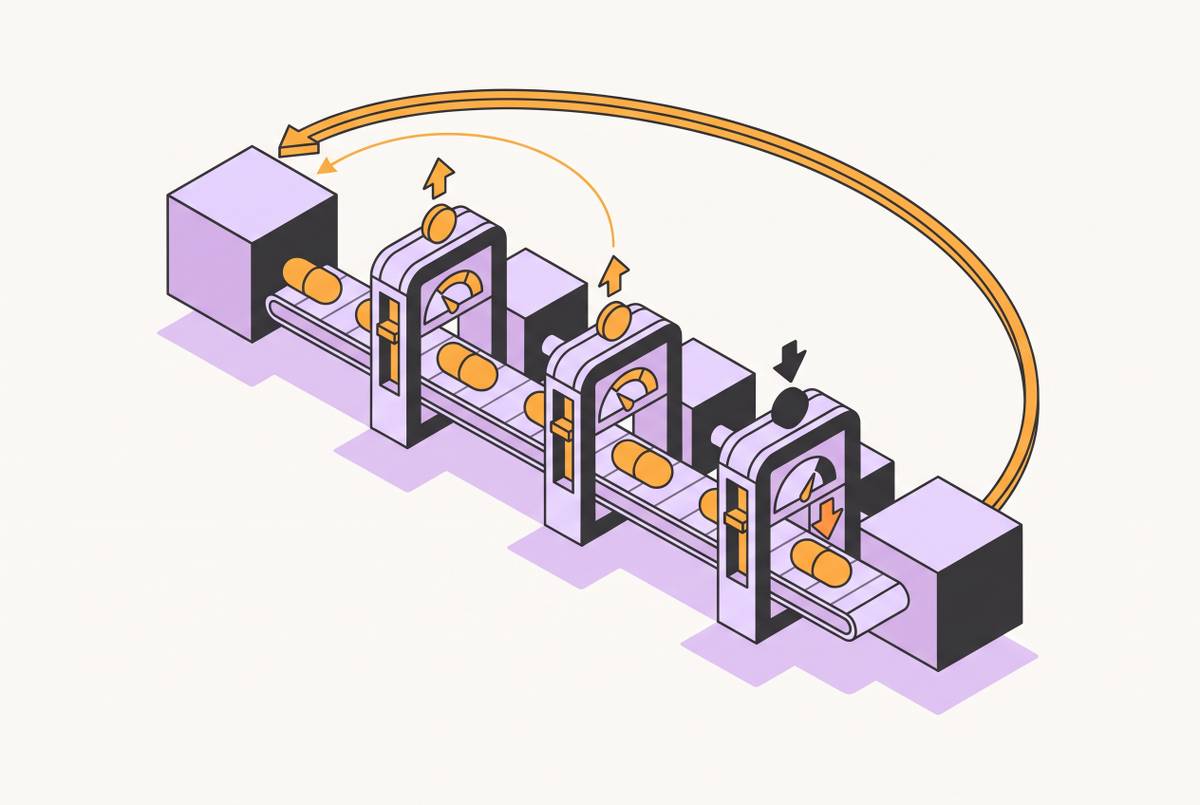
Lemma, in practice, audits every trace against the agent's own instructions, groups deviations into actionable issues automatically, alerts in Slack, and integrates with coding agents so the fix happens without context-switching out of the development workflow. The offline-plus-production stack works as two complementary layers, not competing ones. Offline evals catch regressions before deploy: BFCL v4 for tool selection and argument correctness on known schemas, tau-bench for multi-turn sequencing, and a two-pass MCP CI gate for documentation regressions. Production monitoring catches the long tail that no dataset anticipates. When a production trace surfaces a new failure pattern, whether it is an argument type the agent consistently gets wrong on a specific schema or a loop it enters under a particular tool-failure state, that trace becomes the seed of the next offline eval case. The feedback loop closes, and the eval suite gets better every time production teaches it something new.