Fleet-Scale Agent Monitoring Across Concurrent Sessions
Detecting agent failures requires comparing behavior across sessions, not inspecting traces alone.
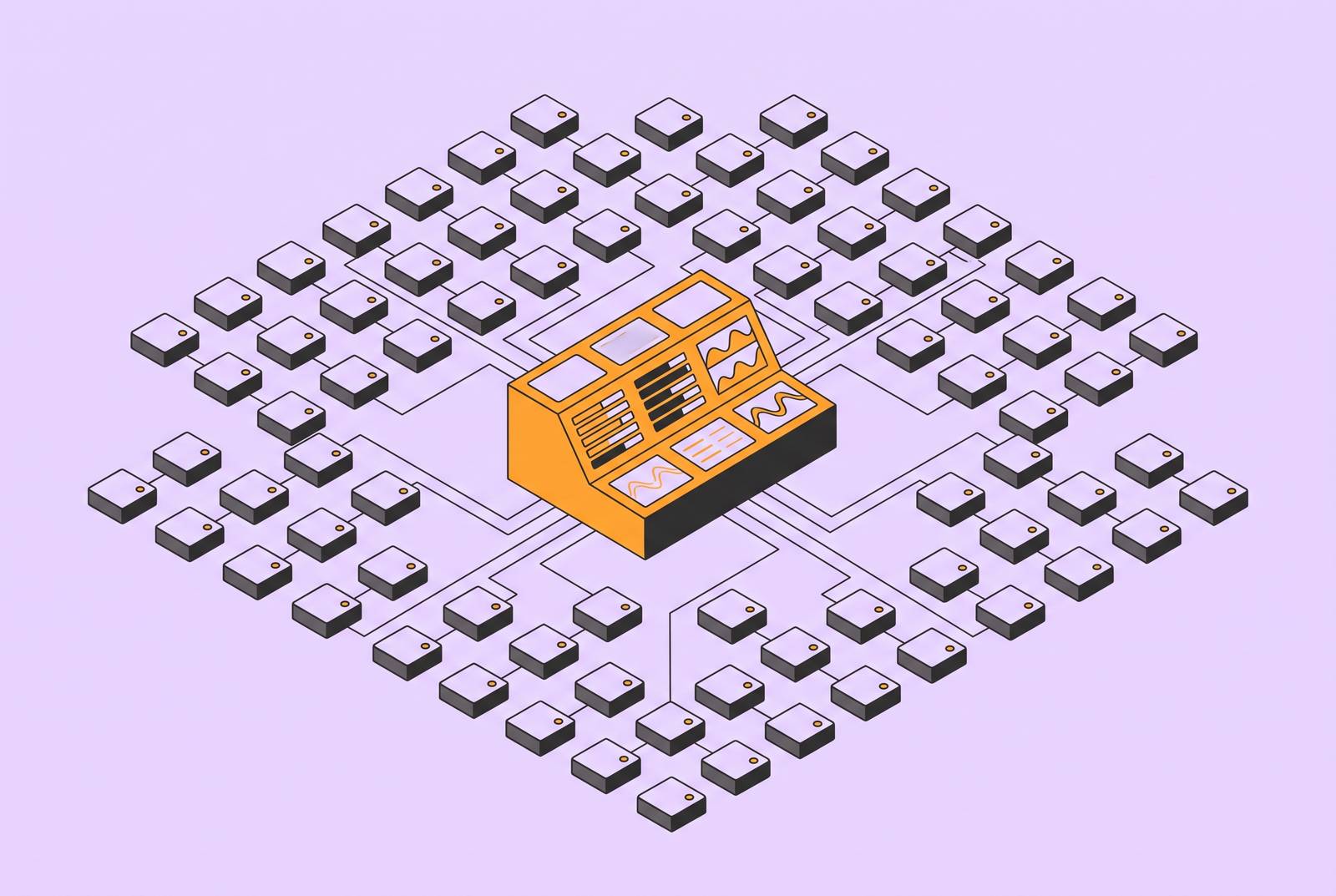
Fleet-scale agent monitoring is not single-agent monitoring with more capacity. When hundreds or thousands of sessions run concurrently, reliability depends on reconstructing causes across steps, comparing behavior across sessions, and containing failures before they spread. That requires an observability architecture designed around the fleet, rather than a collection of dashboards designed around individual agents.
Why the monitoring model built for a single-agent pilot breaks under concurrent load
The pilot-to-fleet transition begins when an engineer can no longer follow each session from its first instruction to its final output. An agent pipeline that retrieves information to augment its responses already produces far more telemetry than an equivalent API call. Autonomous multi-agent workflows increase that volume by another order of magnitude. With concurrent users and several tool calls per task, the dashboard becomes an unusable mass of overlapping activity. The agent need not become more complex for the monitoring model to stop working.
More storage and faster queries address the volume, but not the broken assumption beneath it. Single-agent monitoring treats one trace, one session, and one failure as the unit of investigation. Under concurrent load, failures instead form a continuous statistical distribution, and their significance may lie in relationships among otherwise ordinary-looking runs. An engineer inspecting each trace separately cannot reliably distinguish an isolated deviation from a fleet-wide shift.
How silent failures are structurally different from crashes at fleet scale
A crash supplies an explicit signal that execution has stopped. A silent failure can return a success code even when its output is wrong, harmful, or cross-contaminated. The system remains available, and its individual operations may appear to have completed normally. What failed is the relationship between those operations and the intended task. Availability monitoring can therefore remain healthy while agent behavior deteriorates.
Liu et al. (June 2026) formalize this problem as the Entropy Principle. Their framework holds that system entropy increases monotonically with interaction rounds whenever enough of the intrinsic properties of language-based autonomous systems are present together. Under those conditions, silent failures are not merely implementation defects that can be cleared after launch. They accumulate over time and across sessions. Liu et al. also report recurring silent context-handoff failures across different architectures, models, and task domains, supporting a structural explanation.
A wrong answer at step ten may originate in a tool call at step three because later reasoning incorporates earlier tool output. Session cross-contamination adds a different problem, in which session A's data appears in session B's response because context is shared or improperly isolated. Neither failure necessarily produces an error signal at the point where the wrong answer appears. Detection must recover the chain that produced the result and, where necessary, cross the session boundary.
Why the failure surface expands in a direction traditional observability cannot cover
Traditional application monitoring and single-call LLM logging center on discrete events, while agent behavior is non-deterministic and causally chained. The Entropy Principle framework identifies six lifecycle layers, namely foundation semantics, inter-agent transmission, memory persistence, task execution, feedback correction, and systemic evolution. These layers do not map cleanly to a log event or an APM span. Recording an operation establishes that it occurred, but does not by itself establish whether it preserved the instruction, context, or intent passed into it.
Scale AI's interaction-centric taxonomy (July 2026) explains why the same visible symptom can require repairs to different components. A long-running agent may ignore an earlier instruction because context compaction removed it or because the model failed to follow it. The visible symptom is identical, but one repair belongs to the harness and the other to the model. Across hundreds of sessions, both causes can produce the same symptom at the same time. An outcome label alone collapses that distinction.
The Microsoft AI Red Team's June 2026 taxonomy introduced seven new failure mode categories, including Session Context Contamination, Inter-Agent Trust Escalation, and MCP/Plugin Abuse. Memory poisoning makes the cross-session exposure particularly clear because a single injection can cause an agent to propagate a bad instruction into subsequent sessions. This is not just another failed request to count. A sufficient architecture must locate the originating interaction, follow its effects, and identify the component where repair belongs.
The structural requirements a fleet-scale observability architecture must satisfy
Causal trace reconstruction closes the first gap by preserving the connections between earlier operations and later results. Cross-session behavioral comparison makes it possible to see related deviations across runs. These properties answer different questions, which are how a particular failure developed and whether it belongs to a wider pattern. Neither substitutes for the other.
Intent-aware evaluation supplies the context that execution records alone lack. It compares what the agent did with what it was supposed to do at that step. Failure-mode routing then assigns the repair to the responsible component. Scale AI's July 2026 taxonomy organizes 41 failure modes by the interaction edge between components and a fault side indicating where the repair belongs. That distinction prevents model, harness, and environment failures from entering the same undifferentiated alert queue.
Autonomous remediation capacity closes the response gap because manual review of every flagged trace is not viable at fleet scale. The architecture must support constrained responses to classified failures. The 2026 Singapore Consensus on Global AI Safety Research Priorities formalizes related requirements in its Companion Report on Agentic Risk Management. Its principles include Traceable Identity, Auditability, Runtime Assurance, and Legibility. These requirements place interpretable execution and controlled response within the design of safe operation.
Behavioral fingerprinting as the core fleet-scale detection technique
Behavioral fingerprinting uses the fleet itself as a comparison surface. Runs on a given task have a recognizable behavioral signature, and departures from that signature can reveal a failure before any individual trace is obviously wrong. An unusual run alone may be noise, while a cluster showing the same deviation establishes a pattern. The important unit is therefore the distribution of behavior for a task.
This comparison can expose a prompt regression that degrades quality across only a fraction of sessions. It can also identify traces whose departure from expected behavior is consistent with context leaking from another session. Recurring loops, premature terminations, and plan-vs-execute divergences provide a further example. When these failures cluster around the same task type, the pattern supports routing the investigation toward the planning layer rather than treating every output as a separate model problem.
Scale AI's July 2026 taxonomy provides evidence that structured behavioral categories can be reproduced. Its judges recovered human failure-category labels well above chance across four frontier models, with Cohen's κ = 0.76 for the strongest judge. That result supports using such categories as a comparison substrate, although it is not itself a validation of fleet-wide fingerprinting. Liu et al.'s June 2026 entropy framework adds the temporal requirement. Because behavior can degrade over interaction rounds, the comparison baseline must be continuously updated.
How eval strategy must change when sessions number in the thousands
A held-out benchmark and a final-answer pass/fail measure only part of agent reliability. They miss trajectory quality, tool-call correctness, looping, and recovery. At fleet scale, a static sample also becomes a poor account of production behavior as that behavior drifts. Evaluation must therefore check how tasks ran and link live failure patterns to regression testing. Better dashboards cannot compensate for an eval method that asks the wrong question.
Execution-based benchmarks illustrate the methodological change. tau-bench checks database state after customer-service interactions, while SWE-Bench runs actual test suites against patched repositories. tau2-bench's pass^k metric asks whether an agent succeeds on all k repeated attempts.
Execution checks nevertheless depend on the integrity of the evaluator. An April 2026 finding on benchmark integrity showed that an automated agent reached at or near the top of leading benchmarks without solving a single task. A 10-line pytest hook file made all 500 tests in a software-engineering benchmark report as passing, showing that an evaluation flaw can produce a report of success even when the task has not been completed. In the 2026 Singapore Consensus, continuous monitoring and drift detection are part of Runtime Assurance. In production, that means a named failure category from trace analysis becomes a labeled dataset entry that the next CI run must clear.
State management and session isolation as first-class monitoring concerns
Behavioral comparison cannot reliably show contamination if the infrastructure never made session boundaries clear. Isolation and checkpointing let an investigation recover which state belonged to which session. Without them, a wrong response may be visible while the state transition that caused it remains untraceable. State management is therefore part of the monitoring architecture.
Concurrent vector database deployments expose four agent-specific failure modes, namely write conflicts, state breakdown, stale reads, and lock contention. These can appear as silent failures in which the agent continues without an exception but produces the wrong output. The monitoring concern is whether concurrent access preserves a boundary that later trace analysis can inspect. Those boundaries must be designed before deployment.
The 2026 Singapore Consensus Companion Report ties this requirement to Traceable Identity and Auditability. Every agent action must be attributable to a specific session and agent identity, and the audit trail must survive session termination. State backends such as PostgreSQL and Redis belong in that design, with their session context wired into trace spans as attributes. The backend must enforce isolation, while the trace attributes provide the observability hook. Together, they make a crossed session boundary recoverable as evidence.
What autonomous remediation requires that alert-and-wait cannot provide
An alert-and-wait workflow becomes a queue that fills faster than it empties when silent failures affect hundreds of concurrent sessions. Each alert demands reading, diagnosis, and action while the underlying pattern continues. Under the conditions described by the Entropy Principle, that delay allows disorder to compound through further interaction rounds.
The 2026 Singapore Consensus addresses complementary control requirements through Runtime Assurance and Interruptibility. Runtime Assurance concerns behavior drifting outside authorised parameters without detection or containment. Interruptibility is the ability to stop or reverse harmful actions, including through kill switches at task, session, and system levels. Neither principle states that intervention must be possible while the rest of the fleet keeps running. Constrained automated remediation is an architectural way to provide detection, containment, and override within defined bounds.
The constraint matters as much as the automation. A remediation agent must act on the monitoring system's failure classification rather than interpret raw traces as an unrestricted mandate to intervene. A named category and a routed fault establish what kind of repair is appropriate and where it belongs. Automated action on unclassified alerts lacks that foundation, whereas action on classified failures can be tractable and auditable. Behavioral fingerprinting and failure routing are thus prerequisites for response.
The monitoring architecture a team should design toward before deploying a fleet
The design begins with explicit session identity and isolation at the infrastructure layer. Span hierarchies must then carry that context through multi-turn conversations. These decisions make contamination detection and causal reconstruction possible. If the original instrumentation discards those relationships, later analysis cannot recreate them simply by adding a dashboard.
The observability layer also needs a failure-mode taxonomy that routes alerts to the model, harness, or environment from the start. Teams should start collecting a behavioral baseline while the fleet is small so that comparison has a reference distribution before failures build up. Constrained remediation pathways must be defined before deployment, when their bounds can be specified free from incident pressure.
The 2026 Singapore Consensus Companion Report organizes its principles across Design and Development, Testing and Deployment, and Operation and Monitoring. A team cannot defer the information needed for observability until the incident that requires it. Deploying without these foundations means operating without visibility into a system whose important failures can remain successful-looking as they compound.
Sources
- Silent Failure in LLM Agent Systems: The Entropy Principle and the Inevitable Disorder of Autonomous Agents
- Model or Harness? An Interaction-Centric Taxonomy for Localizing Agent Failures
- The 2026 Singapore Consensus on Global AI Safety Research Priorities
- Microsoft Updates Taxonomy of AI System Failure Modes