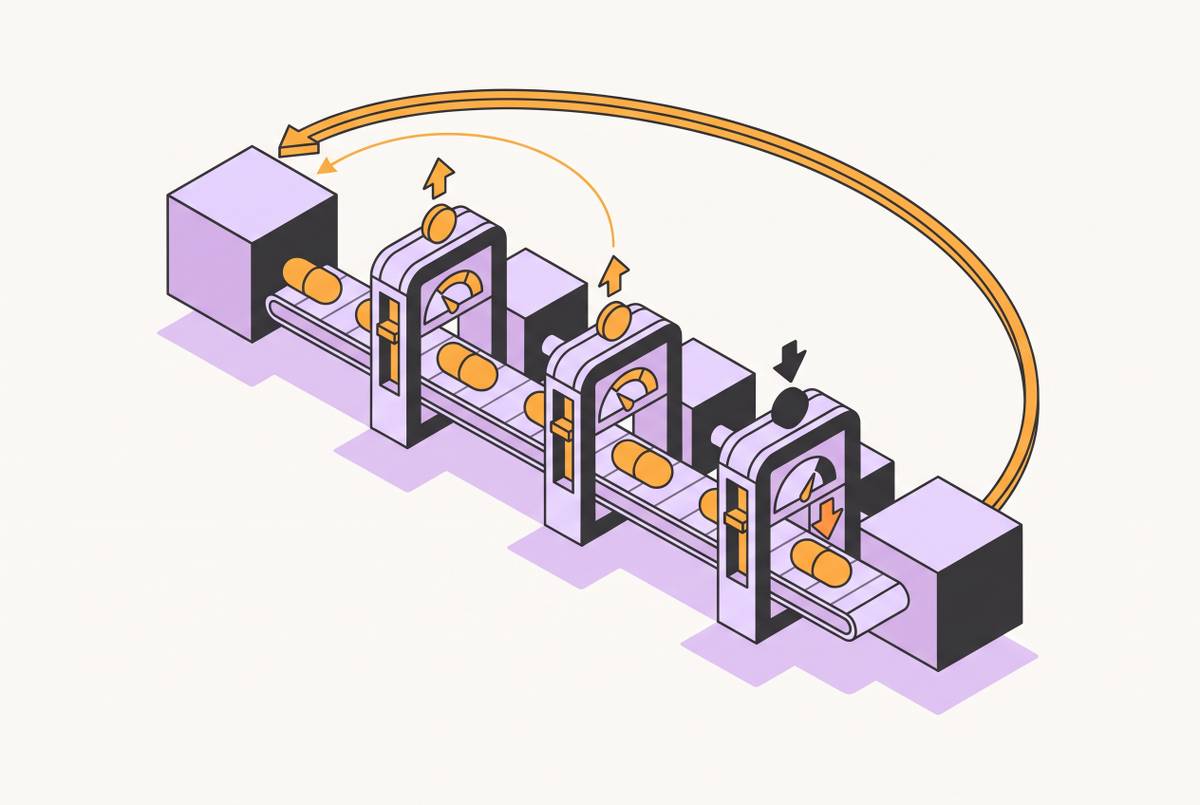
LLM Judge Reliability in Agentic Eval Pipelines
Judge design alone cannot catch what multi-step agent systems require.

LLM judge reliability in agentic eval pipelines depends on more than the quality of the judging model. The biases already found in text evaluation meet a different problem when agents use tools and take steps that depend on each other. Trustworthy evaluation requires measuring the judge against the full trajectory and verified ground truth, rather than treating a plausible final answer as evidence of a reliable system.
Why the agentic context is structurally different from text-centric eval
A text-centric judge can inspect the whole unit of work in a response. Dialogue, summarization, and instruction following helped establish LLM-as-a-judge as the dominant scalable evaluation approach in NLP pipelines because that response is the main object being assessed. A tool-calling agent produces a different object, which is a dependency chain of actions and intermediate states. Its final response is only the last node. Reading that node does not reveal the bulk of what determined the system’s quality.
The resulting gap is about scope before it is about calibration. Better prompting cannot help a judge check steps it never sees. Stephanie Jarmak’s engineering monograph shows how coding agents are tested as models but put to work as systems. Apparent model failures can originate in the harness, execution state, retrieval, or state management. A judge that treats the final output as a model output can therefore assign failure to the wrong layer.
Pass@k captures success across attempts, whereas pass^k tests all-runs consistency. Stochastic exploration can make the former look strong while the latter exposes unreliable execution. A single successful trajectory can likewise give a judge a best-case view, with repeatability still untested. The mistake is not using judges, but applying judges designed for static outputs to dynamic, multi-step systems without checking whether their assumptions still hold.
The bias profile judges bring into any pipeline, before agentic complexity compounds it
Even when the response is the right unit to evaluate, LLM judges do not provide a clean baseline. Their systematic biases can remain hidden behind aggregate accuracy, and no judge evaluated across the cited benchmarks was uniformly reliable. Position bias is one example, with judges favoring whichever response appears first. BabelJudge measures this through gold-labelling by degradation, setting up comparisons where the correct labels are known and checking whether swapping the response order changes the verdict. This isolates sensitivity to presentation from the ability to identify the better answer.
Verbosity bias adds another non-semantic cue by rewarding longer answers even when they add no information, after content quality has been controlled for. Self-preference and family bias can also inflate win rates for outputs from the judge’s own model family. A judge causes harm when it fails to penalize its own errors. Cross-lingual degradation further weakens reliability in lower-resource languages in ways raw accuracy understates. BabelJudge uses a composite bias-penalized reliability score to make that gap more visible.
These problems interact rather than operating as separate deductions from an otherwise sound score. FairJudge, by Bo Yang and colleagues in February 2026, identifies a compounding structure involving criterion mismatch, non-semantic bias, and score-comparison inconsistency. A judge applying the wrong rubric can also respond to surface cues and assign scores that contradict its pairwise decisions. Correcting the most visible bias while others remain can leave a pipeline looking better calibrated than it is.
The RAND Corporation’s February 2026 Judge Reliability Harness, by Sunishchal Dev, Morgan Sandler, and colleagues, tests this distinction directly. Its consistency and discriminative tests found breakdowns under formatting changes, paraphrasing, and verbosity shifts. No judge was uniformly reliable across safety, persuasion, misuse, and agentic benchmarks. These are stress-test findings. Teams that choose judges by aggregate accuracy thus bring weaknesses into agentic evaluation that the metric they used to choose them may never have shown.
How agentic tool-calling surfaces three failure modes that text-centric evals do not expose
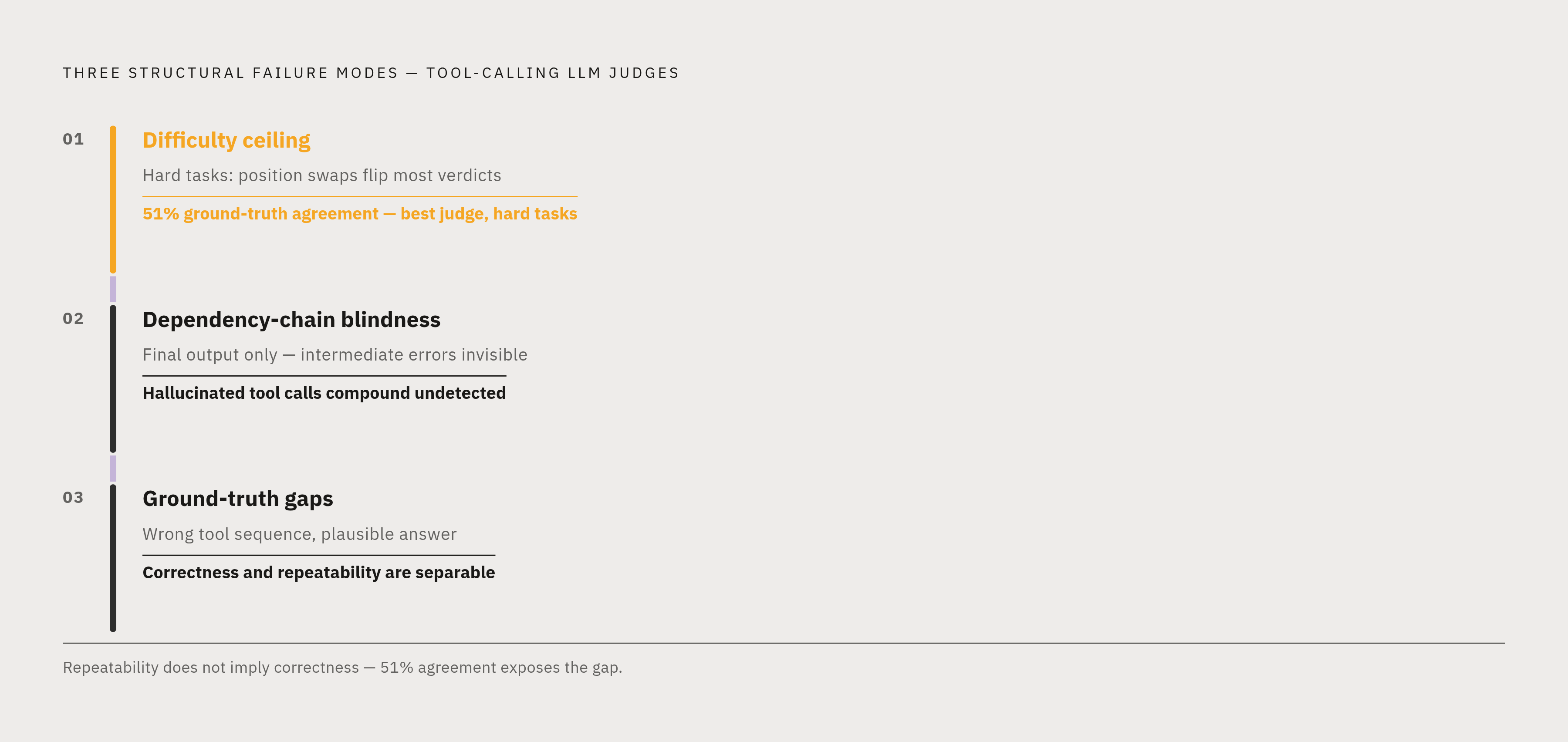
Agentic tool-calling adds three structural failure modes to that already flawed baseline: difficulty-driven alignment ceilings, dependency-chain blindness, and ground-truth gaps. A judge can encounter all three within one pipeline, and improving one does not establish reliability on the others. Their common feature is a mismatch between what a response judge can assess and what a multi-step task requires.
Difficulty-driven alignment ceilings arise because judge accuracy does not degrade evenly across tasks. Hard tasks create ambiguous intermediate states with less signal for distinguishing valid behavior from invalid behavior. Position, length, and format can then carry more weight in the verdict. A 2026 study that stress-tested six frontier LLM judges across four benchmarks, five prompt formats, two presentation orders, and three temperatures found that position swaps flipped most verdicts on hard tasks. The judge with the most consistent output agreed with ground truth only 51% of the time.
That result separates repeatability from correctness. The same study introduced a “trustworthy verdict rate” to expose the interaction between task difficulty and judge reliability, and found holistic rubric scoring more trustworthy than pairwise win-rate. Verdicts also flipped across identical replications at temperature zero. The instability was therefore not purely a sampling artifact, but also reflected cloud serving infrastructure on borderline inputs. AgentJudgeBench also finds that task difficulty sets an alignment ceiling that more model capacity alone cannot raise.
Dependency-chain blindness concerns the evidence available to the judge. Final-output evaluation cannot catch intermediate errors that the agent recovers from in place, errors that quietly build on each other, or tool failures that the response leaves out. BabelJudge makes this testable through nine trajectory-level perturbations, including wrong arguments, swapped tools, hallucinated calls, and missing steps. Its agentic metrics cover tool accuracy, hallucination detection rate, and trajectory-length bias.
MobileJudgeBench provides empirical evidence of the consequences. Judge accuracy changes enough across methods and backbones to change agent rankings and reverse the decisions made from them. It also finds opposite failure profiles in two backbones, one conservative and one permissive, linked to their precision-recall characteristics. Jarmak’s monograph explains the related system boundary, showing that improvements at one layer often fail to propagate to end-to-end outcomes.
Ground-truth gaps concern what counts as a valid chain in the first place. Text tasks can use reference responses, but agentic tasks often have many valid tool-call sequences, and a wrong sequence can still produce an answer that looks correct. Adding more reference answers alone cannot clear up that ambiguity. AgentJudgeBench makes trajectory validity an explicit evaluation target with programmatically verified ground-truth traces across DAG topologies at controlled difficulty tiers.
Why these judge failures are invisible to the metrics most teams are already watching
Aggregate benchmark accuracy is an average across cases, so high scores on easy tasks can hide repeated failures on hard, borderline inputs. An agent may need to handle precisely those inputs reliably to be deployable. The RAND Judge Reliability Harness found weaknesses through stress-testing because a benchmark score alone does not show when changes that should leave a judgment intact can affect it. A stable average is not evidence that those sensitivities are absent.
Success metrics can compound the concealment. An output-level judge can then accept the answer while remaining blind to wrong arguments, hallucinated calls, or missing steps within the successful trace. The output score may be correct on its own terms. What it cannot establish is whether the agent will succeed when the lucky path is unavailable.
Agent accuracy stayed flat across multiple evaluation windows even as output diversity fell sharply. No standard metric detected more than three of the seven production failure modes studied, and four were missed entirely. A judge has no basis for raising an alarm about a dimension its assigned score does not cover.
Ranking-based decisions inherit this limitation. MobileJudgeBench’s ranking shifts show how judge error can change which model gets chosen or how it gets trained without the reported agent score warning of the error. A conservative judge and a permissive judge can produce different conclusions from the same class of trajectories, even when each returns orderly results. The first step is therefore not to fix the judge in the abstract. It is to instrument judge reliability itself, using measurements distinct from those that assess agent performance.
What a calibrated agentic eval pipeline needs to measure differently
A calibrated pipeline needs three changes, which are trajectory-level graders, calibration against verified agentic ground truth, and judge reliability reported as a first-class metric. These changes separate what can be verified from what still requires judgment. Output-level assessment can still judge the response. It should not carry responsibility for validating evidence it cannot see. The trace and the answer need related but distinct checks.
Code-based graders should handle the parts of a trace with verifiable ground truth. String match, regex, outcome verification, and static analysis are fast, deterministic, and blind to non-semantic cues. Where the task defines the correct tool, arguments, or sequence, these graders can check those requirements directly. BabelJudge’s trajectory perturbations offer a way to test the parts of the assessment that still need a judge. Running those tests before making a judge the sole arbiter reveals whether it can detect specific defects in otherwise plausible output.
Calibration also needs both a reference set and a tracked agreement metric. A human-labeled gold set ties judge scores to expert review, while verified traces test whether that agreement extends to agentic execution. AgentJudgeBench offers a structural model with 3,808 function-calling records spanning six topologies and three difficulty tiers. The controlled difficulty tiers matter because a single agreement score can hide deterioration on harder workflows. Calibration against outputs alone leaves the ground-truth gap in the dependency chain untouched.
Rubric design and backbone selection belong within that calibration process. ReVeR derives rubric criteria from the instruction alone rather than from the responses being judged, addressing response-induced bias at the design level. Holistic rubric scoring offers better trustworthiness than pairwise win-rate on hard tasks in the multi-benchmark stress test. MobileJudgeBench finds that the backbone, rather than the elaborateness of the judge pipeline, is the primary driver of quality among competitive methods. That supports putting work into choosing a backbone and calibrating it before adding more complex judge scaffolding.
Judge health should then be reported with agent performance. The trustworthy verdict rate can be broken down by how hard the task is, while consistency checks test the effects of temperature, prompt format, and presentation order. Temperature-zero flips should be treated as structural instability. The RAND Judge Reliability Harness is an open-source way to stress-test consistency and discriminative reliability before judges are used in CI gates.
Observability supplies the evidence these checks require. Capturing every tool call, argument, and reasoning step as structured spans at runtime makes failures inside the trace available for inspection. Understanding why the agent acted as it did requires that internal sequence. Monitoring tool call frequency and failure rates by type can expose silent failures that do not move latency metrics but corrupt answer quality.
The feedback loop should connect that evidence to future tests. Production traces that fail quality gates should automatically become eval cases, so the golden dataset grows from real failures as well as synthetic cases. A trustworthy agent score ultimately depends on both the evidence supplied to the judge and the demonstrated reliability of its verdict. Measuring both is what turns judge-based evaluation into a defensible signal about the deployed system.
Sources
- BabelJudge: Measuring LLM-as-a-Judge Reliability Across Languages and Agent Trajectories
- Benchmarking LLM Judges for Mobile Agent Evaluation
- AgentJudgeBench: A Multi-Difficulty Benchmark for Evaluating LLM Judges on Agentic Tool-Calling
- Engineering Reliable Coding Agents: Evaluating and Operating the System Around the Model