Regression Detection in Agent Pipelines After Prompt Changes
Why prompt edits slip past standard testing to break agent behavior silently.

Prompt changes trigger more silent behavioral regressions in agent pipelines than any other release event, and they are the hardest of the three to catch. A code change produces a diff. A model update gets treated, at most shops, as a formal release with its own review process. A prompt edit is often one sentence reworded by someone on a Tuesday afternoon, shipped without a gate, and it can quietly change what the agent decides to do while every metric stays green.
Prompt changes as a dangerous release event for agent pipelines
A code change gives a linter, a type checker, and a test suite something to grab onto. A prompt change gives them nothing: the change is natural language, and its effects live entirely in behavior, not syntax. Teams that would never ship a model upgrade without a formal evaluation pass will reorder two instructions in a system prompt and push it straight to production, because it feels like copy editing. Nothing about the pipeline's instrumentation disagrees with that feeling: success codes stay the same, latency stays the same, error rates stay the same. What changes is what the agent chooses to do inside a call that still reports success. Microsoft's April 2025 taxonomy of failure modes in agentic AI systems names cross-domain prompt injection and memory poisoning as failure types that aren't new on their own but get materially worse once an agent is making autonomous decisions across steps. The same amplification applies when the prompt drift is unintentional and comes from inside the team. A small wording change, run through a system that acts on its own judgment across multiple steps, can produce an outcome nobody wrote and nobody notices.
How agent behavior changes after a prompt edit
A prompt edit rarely breaks an agent across the board. It shifts behavior on a slice of inputs, usually the ones that were never in anyone's test set to begin with. Take a support-routing agent whose triage-priority instruction gets reworded for clarity. The happy path, a clearly worded ticket about a clearly broken feature, still routes correctly. But a class of ambiguous tickets that used to get escalated now gets deprioritized, because the new wording shifted how the agent weighs urgency language it hasn't seen explicitly. Nothing in the trace looks wrong: the agent called the right tools, returned a valid response, and closed the loop. In a multi-step pipeline this gets worse, because the bad decision becomes the input to the next step. If a planning-layer prompt change slightly alters tool-selection logic, it can produce the wrong tool sequence, hand downstream reasoning a plausible-looking but wrong result, and the final output reads as reasonable enough that no one flags it. The five-category failure taxonomy maps this precisely: planning errors show up as wrong tool sequences or loops, tool errors as wrong tool, wrong arguments, missing error handling, or a fabricated tool, and reasoning errors as factual mistakes, math errors, ignored instructions, or hallucination on grounded context. A single prompt edit can move an agent from one of these categories into another without triggering a crash anywhere in the chain. The failure type to watch for most closely after a prompt change is false success: the agent asserts the task is done, the call returns a 200, and the environment state or the downstream system quietly ends up wrong.
Why Standard CI and Error Monitoring Miss This Regression Class
Code-level CI and error monitoring tools check whether execution happened correctly. They have no way to check whether the agent's reasoning on an ambiguous case has quietly shifted, because that question was never part of their design. Unit tests confirm that a function returns an expected value for a fixed input, and a 2026 analysis found that unit tests caught close to 0% of this specific class of undetected agent failures. Error monitors are built to fire on exceptions, failed status codes, and latency spikes, and a prompt regression that produces a confident, well-formed, wrong answer trips none of those wires. Integration tests fare no better: they tend to cover the happy path the prompt author had in mind when writing them, and the regression appears precisely on the inputs outside that path. Microsoft's updated taxonomy adds a sharper warning here. Human-in-the-loop bypass turned out to be the single most consistently exploited failure mode in deployed agentic systems, occurring at very high frequency, found through consent fatigue, probabilistic invocation manipulation, and incremental escalation chains. The review step teams count on as their safety net is, in practice, one of the weaker links. Effective oversight of an agent requires knowing what it was supposed to do, not just what it did, and metric-based monitoring was never built to answer that question. Asking teams to predefine every failure mode in advance doesn't close the gap either: a prompt change can introduce a failure that nobody anticipated, because the failure only exists as an interaction between the new wording and a specific slice of real input. If none of the existing tooling is built to catch this, the question becomes what a detection approach built for this specific failure class actually looks like.
The detection principle: evaluating what the agent was supposed to do against what it did
Catching a prompt-change regression starts from a different ground truth than code testing uses: not a fixed expected output, but the agent's own instructions. The system prompt is the specification. It states what the agent is supposed to do, in what order, under what constraints, and for what reasons. A regression, under this view, is a gap between that specification and what the agent actually did on a real production trace. It's a behavioral divergence between the instruction and the action taken. This reframes what gets evaluated: not a response checked against a fixed expected answer, but a trace checked against the instruction set that was supposed to govern it. Curated input-output pairs used for model benchmarking still have a place, since they catch known failure patterns reliably. But they can't cover a behavioral shift that a brand-new prompt wording introduces for the first time, because by definition nobody has written a test case for it yet. Evaluating live traces against the live instruction set is the only way to catch that shift as it happens. This same principle solves the problem of predefining every failure mode. If the agent's own instructions serve as the rubric, nobody has to guess in advance what might go wrong. Deviations from the instruction set appear trace by trace, across the full range of production inputs, as each one is evaluated against the instruction set.
Building a prompt-change regression detection workflow: the four operational steps
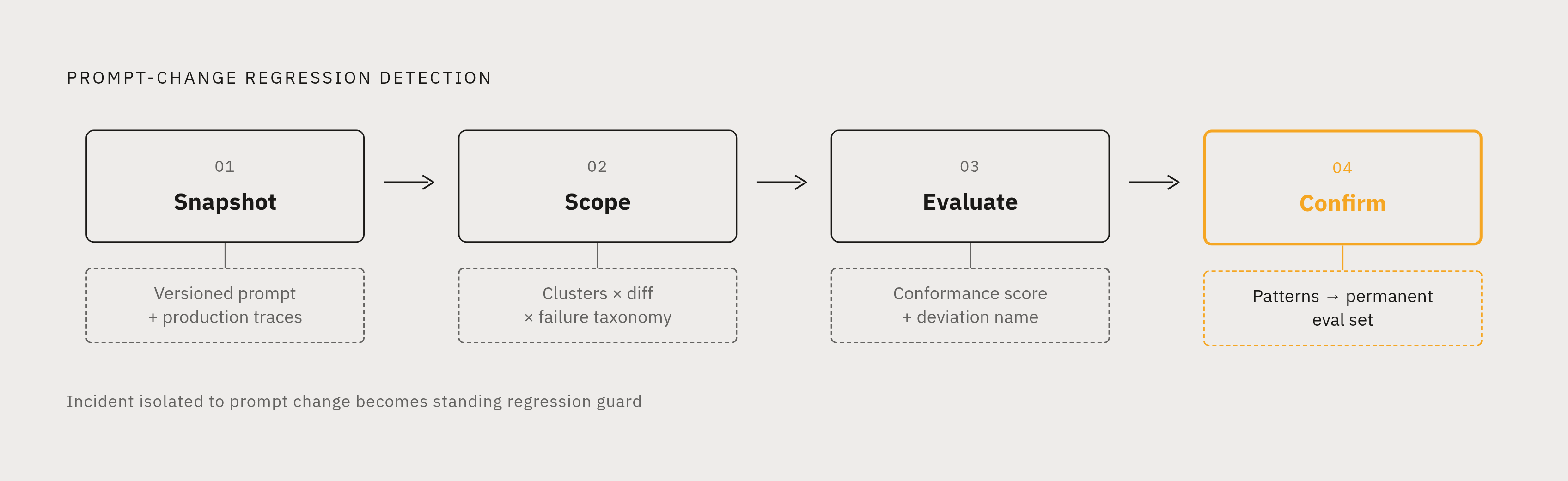
Four steps make this principle operational: snapshot, scope, evaluate, and confirm. Each one produces a specific artifact, not just an idea. The snapshot comes first: before any prompt change ships, capture a versioned record of the current system prompt together with a representative slice of recent production traces. This is the baseline, and it has to reflect real behavior on real inputs. If trace logging isn't already running in production, there's no baseline to measure anything against, so this step becomes the gating investment for everything that follows. Scope comes next: once the new prompt ships, identify which traces in the fresh distribution are actually likely to be touched by the change. Not every trace carries equal risk. A reworded triage-priority instruction will hit high-ambiguity tickets far harder than clear-cut ones, so scoping means clustering traces by input type, task category, and decision point, and cross-referencing the prompt diff against the failure taxonomy so a planning-instruction change routes attention toward planning-layer traces and a formatting change routes it toward response traces. Evaluate is the third step: run each scoped trace against the updated prompt as the rubric, and score whether the agent's behavior conforms to what the instruction was designed to produce, not just whether it matched the literal wording. This is where continuous prompt regression automation earns its keep, triggering a full evaluation suite in CI/CD the moment system instructions change, and LLM-as-judge techniques are a practical way to run this at scale, scoring each trace for conformance against the instruction set itself. The output of this step should be a score plus a named deviation description for each trace, not a bare pass or fail. Confirm closes the loop: group the deviations into recurring patterns, separate genuine regression from ordinary model variance, and verify that a systematic shift actually occurred. One low-scoring trace proves nothing on its own, since it might be a pre-existing edge case or a one-off sampling quirk. A regression is confirmed when the same deviation pattern appears across multiple traces on inputs that used to score correctly, and confirming it also means ruling out other explanations: did the model version change, did a tool schema change, did the input distribution itself shift. Once the prompt change is isolated as the actual cause, the regression cluster becomes a standing regression test, and the inputs that exposed it get folded into the eval set so the same failure is caught automatically the next time the prompt changes.
Where prompt-change regressions hide in multi-step and multi-agent pipelines
In a pipeline with several steps or several agents, a prompt-change regression at one component can stay invisible at that component's own output and only become visible several hops downstream. Picture three agents in sequence: a planner, a retriever, and a response generator. A prompt edit to the planner's tool-selection instruction produces a subtly wrong tool call. The tool returns a result that is technically valid on its own terms but wrong for the actual task. The response generator treats that result as settled fact and builds a final answer on top of it. The answer that reaches the user reads as entirely plausible, and nothing in the retriever's or the generator's own output looks broken, because neither of them made a mistake given what it was handed. This is the same mechanism behind hallucination propagation in multi-agent systems: one agent's prompt-induced drift becomes trusted input for every agent after it, and the odds of catching it drop with each additional hop. Microsoft's updated taxonomy names two failure modes specifically because multi-agent pipelines introduce trust relationships that single-agent systems don't have: inter-agent trust escalation and session context contamination. A prompt change that alters how one agent represents its own output to the rest of the pipeline can exploit exactly those trust assumptions. The practical adjustment to the four-step workflow is straightforward: scoping has to extend across the whole pipeline, not stop at the component whose prompt changed. A prompt change in the planner should trigger trace evaluation across the retriever and the response generator as well, and evaluation checkpoints belong at every agent boundary, not only at the final output, since the intermediate handoffs are where a planning-layer regression first becomes visible.
The eval set as a living regression guard: closing the detection loop back into CI
Every confirmed regression is, in effect, a specification of a failure mode the eval set didn't know about before. Adding it turns a one-time incident into a standing guard against the same failure recurring. The inputs that exposed the regression are real production inputs, drawn from the actual distribution the agent sees, that produced a confirmed behavioral deviation, which makes them about as high-signal as eval data gets. The deviation description written during the confirm step becomes the criterion future prompt changes get evaluated against, so the same pattern triggers a block the next time an evaluation run detects it, and nobody has to rediscover it by hand. This is what continuous prompt regression means in practice: the CI/CD pipeline runs the full evaluation suite automatically whenever system instructions change, and that suite grows with every incident it absorbs. A team that does this consistently ends up with an eval set that reflects its own production failure history rather than a generic approximation of what failures might look like, so each new prompt change gets checked against an increasingly realistic test of behavioral conformance. The named failure categories, planning error, tool error, reasoning error, give teams a way to track which of these their eval set actually covers and which remain thin. A planning-error regression that never makes it into the eval set leaves the pipeline exposed to that same class of failure the next time someone touches the prompt. Alerting is what makes the loop functional day to day: when a new prompt change matches a known regression pattern, the alert should land in Slack or inside the coding agent's own context, where the fix is actually going to happen, rather than sitting in a separate monitoring console that nobody checks until something breaks. If teams skip this feedback step, they end up re-discovering the same regressions by hand every time, and they never build a defense that carries forward.
A prompt-change regression detection program at different stages of pipeline maturity
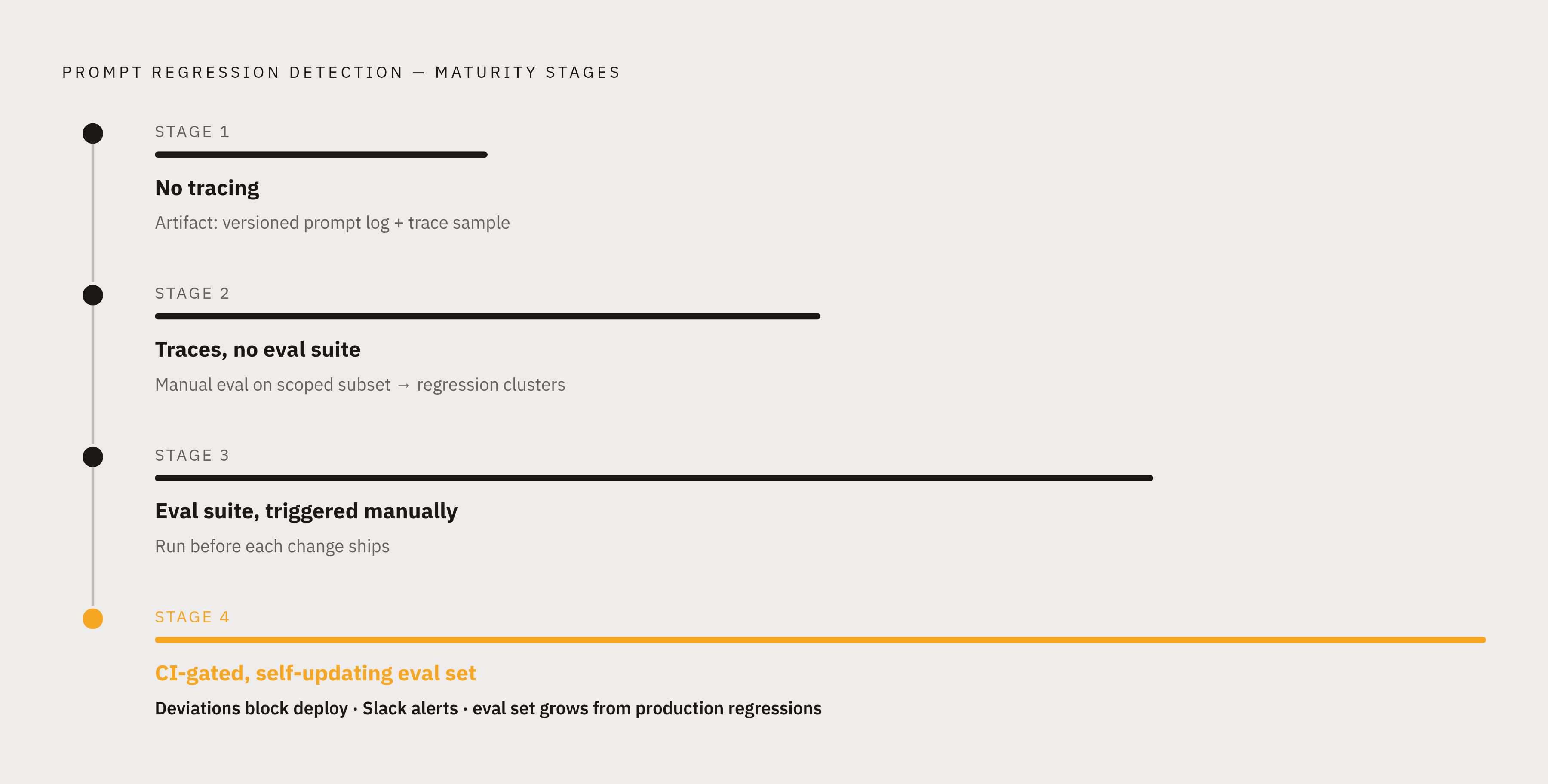
None of this requires full automation on day one. Teams can start with trace logging and a manual evaluation pass, then build toward automated CI gates as the pipeline and the team's confidence in it mature. At stage one, there's no trace logging yet, and the first investment has to be capturing traces in production, since without a baseline none of the later steps have anything to compare against. The minimum viable artifact here is a versioned prompt log paired with a representative trace sample for each prompt version. At stage two, traces exist but there's no eval suite yet, so teams run manual evaluation against the agent's own instructions on a scoped subset after each prompt change. It's slow work, but it produces the first confirmed regression clusters, and those clusters are what seed the eval set going forward. At stage three, an eval suite exists but gets triggered by hand before each prompt change ships. The skill that matters most at this stage is scoping well: running the full suite on every change is possible, but running the right subset is faster and finds the same regressions without the overhead. At stage four, prompt changes trigger the eval suite automatically in CI, deviations above a set threshold block the deploy outright, and the eval set updates itself from confirmed production regressions, with alerts landing in Slack or the team's own coding environment whenever a known pattern matches. The principle holds at every stage regardless of how much automation is in place: start wherever the team currently is, and keep adding every confirmed regression to the eval set, because that habit is what compounds into real protection over time.
Sources
- New whitepaper outlines the taxonomy of failure modes in AI agents
- Updating the taxonomy of failure modes in agentic AI systems: What a year of red teaming taught us
- Silent Failure in LLM Agent Systems: The Entropy Principle and the Inevitable Disorder of Autonomous Agents
- Model or Harness? An Interaction-Centric Taxonomy for Localizing Agent Failures