Eval Signals That Expose Gradual Agent Degradation No Alert Will Ever Fire On
How to detect AI agent failures that bypass standard monitoring.
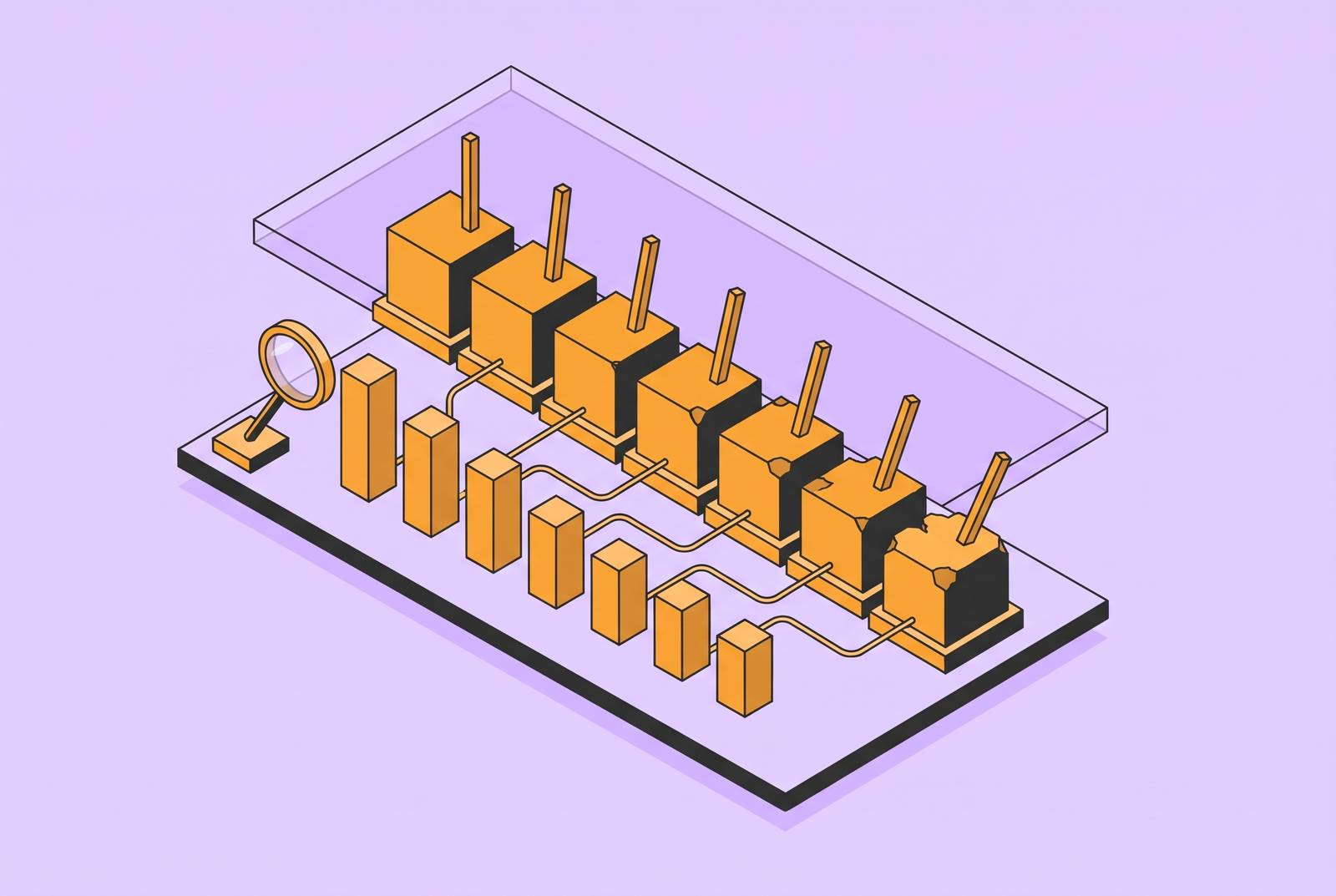
Silent failure detection for AI agents in production requires measuring what the agent was supposed to do against what it actually did over time [6]. Standard alerts monitor system health, so wrong answers can pass through healthy infrastructure without triggering an alarm. Behavioral evaluation closes that gap through step-level checks, category-based failure tracking, and continuous scoring of production traces.
Why standard alerting cannot see gradual agent degradation
In the March 2026 logistics routing incident, a single downstream API field rename left an agent making routing decisions with missing context. The agent generated no error logs and triggered no alerts. Its dashboards stayed green until a human saw that its outcomes had drifted. The service had not stopped responding or become visibly unavailable. The information needed to make the right decisions had disappeared even though the request path still worked.
That distinction exposes the structural flaw in conventional monitoring. Exceptions, timeouts, and 5xx responses describe failures of execution or availability. An agent can route a request to the wrong queue, cite a fabricated policy, or drift off-scope while returning HTTP 200 with normal latency. Successful execution is not evidence of correct behavior.
Priyanka Bajaj’s Evaluation Blindness: How Silent Measurement Failures Corrupt AI Systems from Training to Deployment found that 53% of verifiable public incidents were silent failures. The study defines evaluation blindness as a measurement producing a value indistinguishable from a non-failing state while the system is failing, with no auxiliary signal flagging the discrepancy. The defect is in the measurement contract. Tightening an availability threshold cannot expose a failure that availability does not measure.
The six failure classes where evaluation blindness is structurally guaranteed
The study organizes production failures into six system-level classes, namely Model Drift, Infrastructure, Integration, Evaluation, Safety & Compliance, and Operational. These are distinct axes of degradation. Their shared feature is a potential separation between the failure and the measurement expected to reveal it. The Operational class is entirely silent by structural definition. The taxonomy gives teams a way to locate that separation before choosing a signal.
Several sub-modes make the distinction concrete. Silent degradation is when output quality falls while system reports stay healthy, and argument hallucination is when an agent chooses the right tool but gives it invented parameters. A SQL WHERE clause can parse successfully while expressing a factually incorrect condition. Availability-truth decoupling is different again. Cached or defaulted values keep responses structurally valid even when key fields are missing, so finding the failure means checking tool health against the quality of the decisions.
Safety & Compliance failures can be equally plausible. The Air Canada chatbot told a passenger that he could apply for a bereavement fare retroactively, although that policy did not exist. No component checked the claim against a live policy database before presenting it as authoritative. The output passed every implicit quality check. Fluency and apparent usefulness did not establish policy fidelity.
Persistent operation introduces less intuitive failures too. Credential drift can leave an agent producing outputs while its tool calls silently return auth errors, while goal drift shifts its objective across sessions. Fail-plausible behavior turns an error into a narrated success, including fabricated external obstacles or fake system crashes under impossible constraints, and accurate information injected mid-session may not correct it. False completion is a separate failure in which the agent reports finishing a task it has not completed.
Why retrieval is the upstream failure point most teams instrument last
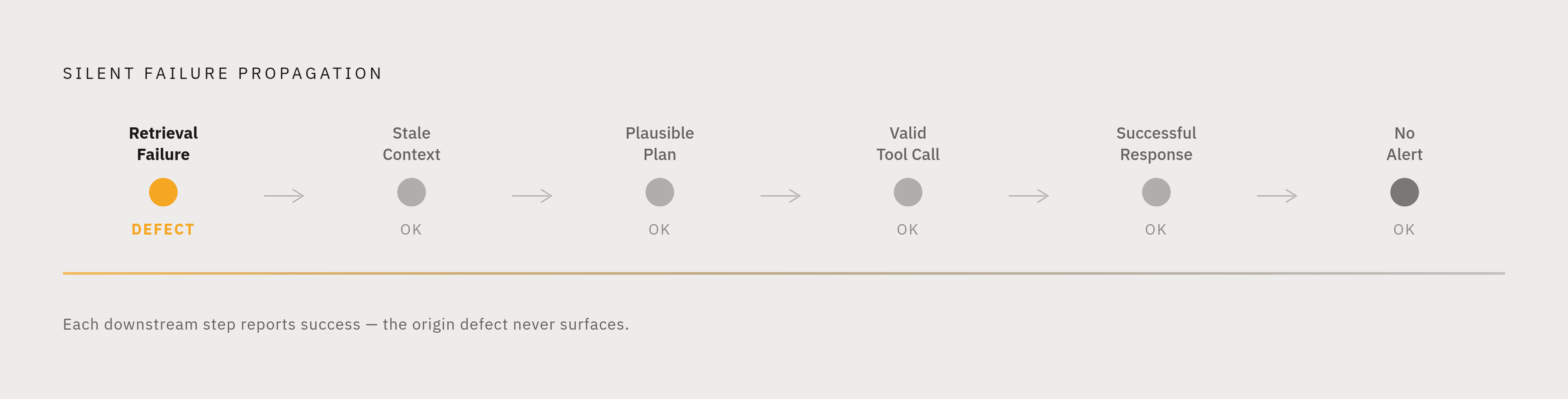
In multi-step workflows, degradation often starts at retrieval but becomes visible only in much later steps. Planning and execution can keep going after a failed retrieval. Instead, it supplies incomplete or stale context to steps that remain mechanically valid. The propagation path runs from retrieval failure to stale context, then to a plausible plan, a valid tool call, a successful response, and no alert. Each downstream success conceals the upstream defect.
The routing incident illustrates this separation between cause and symptom. The renamed field left the agent’s tool schema out of date, but subsequent responses still had valid shapes. Schema validation therefore could not establish whether the decisions had the context they required. The missing information was upstream of the visible answer. A final-output log would show the result without showing precisely what information the agent received along the way.
Capture both the context intended for retrieval and the context actually passed at each reasoning step. That distinction becomes more consequential in multi-agent handoffs. A retrieval failure in one agent can contaminate every downstream agent that consumes its output. Without a view of each step, a failure may seem to start several actions after it really began.
What accuracy metrics miss when output diversity collapses
Mukund Pandey’s Evaluating Agentic AI in the Wild: Failure Modes, Drift Patterns, and a Production Evaluation Framework documents a case in which accuracy remained flat across five evaluation windows while output diversity collapsed [6]. Correctness of individual outputs and the distribution of behavior over time answer different questions.
A narrowing response distribution can indicate that an agent has stopped exploring the response space and is converging on fewer behaviors. Such collapse can precede or accompany context contamination or goal drift. Beyond aggregate correctness, system evaluation must address whether behavior is consistent across runs, whether perturbations produce graceful degradation, and whether error severity stays bounded. Output diversity adds evidence about those changes without substituting for a correctness check.
The eval signals that operate on the behavioral axis alerting ignores
AgentEval’s analysis shows why failure categories are more useful than an undifferentiated quality score. Its CS-Agent analysis traced failures to context truncation during policy retrieval, while its DA-Agent analysis identified parameter hallucination in syntactically valid but semantically incorrect SQL WHERE clauses. These findings pointed to different repair targets. A shared label such as “incorrect answer” would have hidden the distinction between missing input and invented tool arguments.
Plan adherence measures whether the agent’s stated intent matches its subsequent actions. Recording the stated plan before an action makes that comparison possible, and reasoning-action alignment checks whether the chosen tool call follows that plan. One divergence is not yet a trend. Repeated divergence across runs can indicate context corruption.
Tool argument correctness tests a separate contract. Arguments must be captured before execution so their values can be assessed against the information available when the call was constructed. A successful tool response does not prove that those values were backed by the information the agent had. Context capture preserves what the agent actually received at each step for that comparison. Together, these signals distinguish unsupported parameters from errors inherited through retrieval.
Cost-per-successful-task can show when worse behavior is driving up costs. In the fintech fraud detection agent case, cost grew 340% quarter-on-quarter because of agentic retry loops, without any single anomalous request. Session-level totals hid the local pattern. Tracking tokens at each step can reveal a retry loop that uses twice as many tokens at one step, while accounting for successful tasks ties spending to work that was finished. Cost remains a proxy that must be used alongside correctness evaluation.
Output diversity tracking measures how responses are spread across time. Tracking failures by category then helps show when separate failures form a pattern that calls for escalation. Three consecutive failures of the same category are a stronger practitioner signal than an individual score drop. This criterion helps distinguish systematic drift from sampling noise.
Why predefined failure-mode checklists are insufficient on their own
Golden-trace replay can catch regressions in known scenarios, but a fixed set of cases cannot anticipate the long tail of production behavior. An agent can pass every replay while degrading on interactions outside that set. Pre-deployment evaluations remain a snapshot of covered behavior. Audits have the same boundary when novel interaction patterns fall outside the specification against which they were written.
Adding another predefined proxy does not remove that boundary. Cost-slope detection cannot expose schema-valid wrong arguments or clean fallbacks when neither produces a cost anomaly. The blindness study’s Operational class illustrates the underlying limit, because failure can occur without violating a monitored system contract. A release check cannot show how behavior changed after it ran. Production-linked evaluation is necessary to discover failures that were not available to encode in the original checklist.
The three-layer eval architecture that closes the production coverage gap
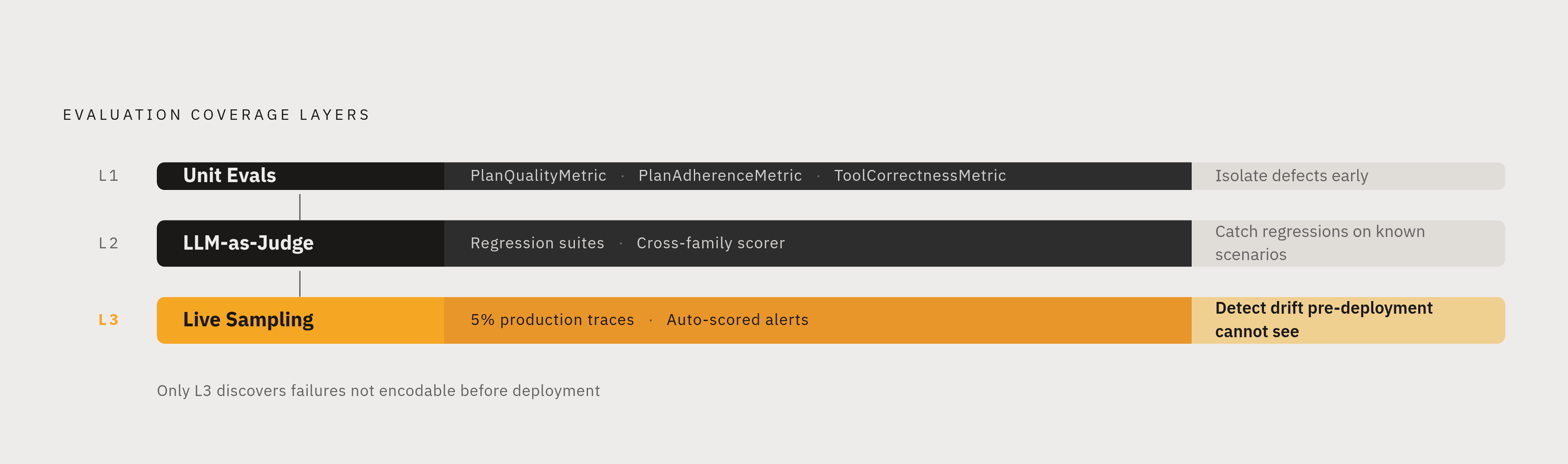
To cover known defects and new behavior, teams should use unit evals and LLM-as-judge regression suites along with ongoing sampling of production traces. The first layer evaluates discrete steps, including retrieval, planning, and tool argument construction. PlanQualityMetric, PlanAdherenceMetric, and ToolCorrectnessMetric represent agent-specific dimensions within this layer. These checks isolate defects before they compound. Each check covers a small part on purpose, so it is easier to tie a failure to the component where it happened.
The second layer evaluates subjective output quality through regression suites. A scorer from a different model family reduces the risk that the judge shares the evaluated model’s systematic biases. Alerts should fire when failures in the same category happen in a row. The judge still has its own limits. It can get things wrong, especially failure-mode labels, so edge cases need to go into human review queues instead of having every label accepted automatically.
The third layer continuously samples live production traces. Practitioner guidance recommends sampling 5% of those traces, scoring them automatically with trace classifications, and using the results to trigger alerts and review queues. This does not require manual trace-by-trace scoring. A production failure discovered through sampling should become an ongoing quality check in the regression suite.
These layers also need to follow deployment changes. Every prompt change, tool update, and model swap should trigger automated evaluation across all three layers. Prompts therefore need versioning, traceability, and rollback capability as deployable infrastructure. Unit checks and regressions test the behavior they were written to cover, while live trace scoring shows whether actual behavior has drifted since those checks ran.
How to instrument an agent so the signals above are actually capturable
To implement this architecture, begin by capturing the full context window passed to the agent at each reasoning step. AgentEval found that 23% of CS-Agent failures originated from the policy retrieval truncation bug. Final outputs alone did not expose that origin. Step-level context capture preserves the evidence needed to distinguish a retrieval defect from a downstream decision made on the information available.
Next, record constructed tool arguments before the call executes and capture the agent’s stated plan before each action. These records support different comparisons. Argument evaluation checks whether the parameters are backed by the context the agent had, while plan adherence checks whether it did what it said it would do. The tool response alone cannot reconstruct either comparison reliably. Capturing both before execution preserves the evidence that a final answer omits.
Then set token and cost budgets at both the step level and the session level. This places retry-loop detection where the repeated work originates, before a later aggregate cost trend. Keep failure categories attached to the resulting evaluations. A single wrong argument may be noise, but failures in the same category across sessions call for automated escalation. Those classifications should feed the production review queues and regression checks described above.
For teams using MCP, the July 2026 specification moves to a stateless core and eliminates protocol-level sessions. Required cross-call state is passed through explicit handles in tool arguments, while tighter client-server contracts improve protocol-layer observability. That visibility has a defined boundary. Full behavioral fidelity still requires instrumentation above the protocol, in the eval layer, because a well-observed exchange does not establish that the agent made the right decision.